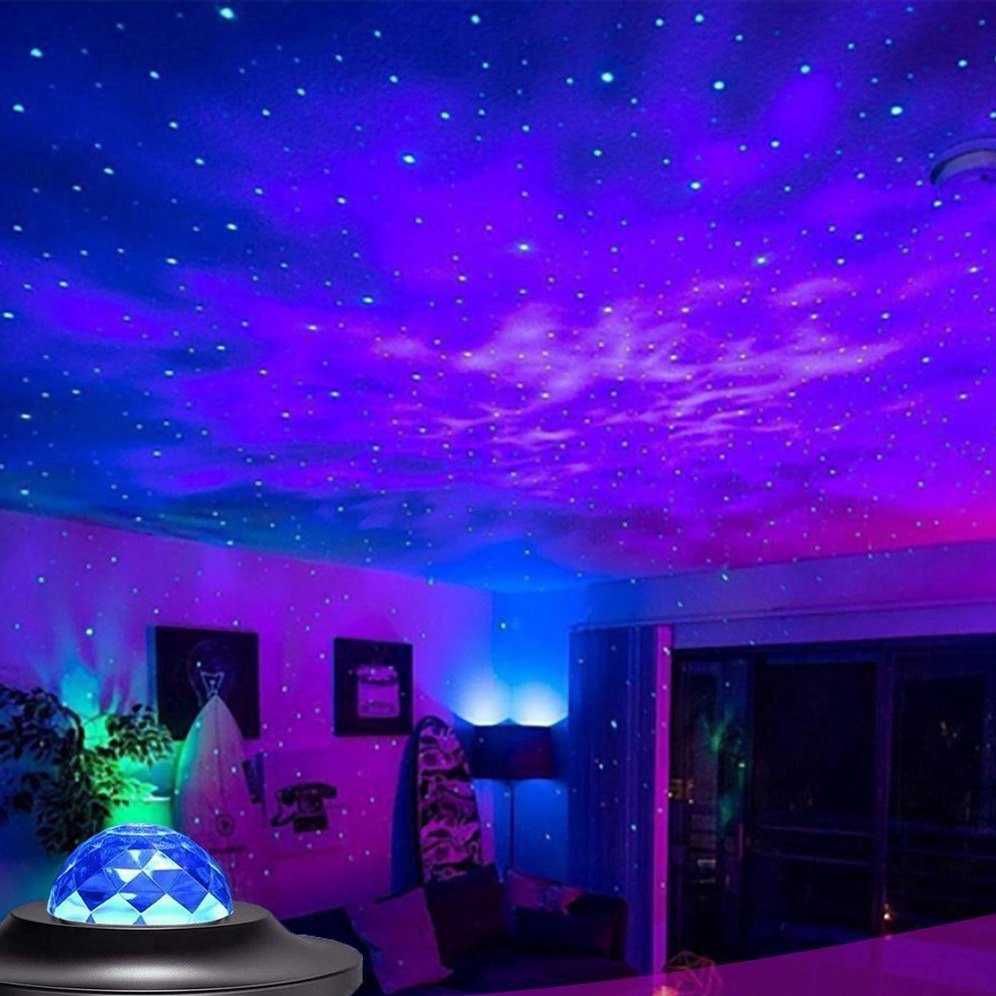
That drifting galaxy on your ceiling looks like magic, but the technology behind it is surprisingly simple. A galaxy projector combines two light sources and a bit of clever optics to fake a deep, moving night sky on a flat surface.
The two layers: stars and nebula
Almost every galaxy projector creates its effect from two overlapping layers.
The stars are usually made by a low-power laser diode shining through a diffraction grating or a pinhole disc. This splits the beam into hundreds of tiny, crisp points of light, which is why laser stars look so sharp compared to LED dots.
The nebula is the soft, coloured cloud behind the stars. It is made by an LED (often an RGBW LED, which can mix red, green, blue and white) shining through a textured, translucent disc or piece of film. As light passes through the texture, it scatters into the cloudy, organic shapes you see.
Why it appears to move
The drifting motion comes from a small, quiet motor that slowly rotates the textured nebula disc. As the disc turns, the scattered light shifts across your ceiling, creating that gentle, hypnotic drift. Better projectors let you adjust the motor speed, so you can slow it right down for sleep or speed it up for a party.
The whole illusion is just two light sources, a spinning textured disc and your dark ceiling acting as the screen.
What makes some look more realistic
- Layering: projecting sharp laser stars over a soft nebula reads as far deeper than either alone.
- Colour mixing: an RGBW LED can blend smooth gradients rather than flat single colours.
- Brightness control: dimming reduces the harsh "projector" feel and makes it dreamy.
- A dark room: the darker your ceiling, the deeper the contrast and the more convincing the galaxy.
Do you need a special surface?
No. Any light, matte ceiling or wall works well. White gives the most dramatic effect. You do not need a projector screen, and you do not need to focus it like a video projector, because the star and nebula effects look good across a range of distances.
Is it safe?
The lasers used in consumer galaxy projectors are very low power and Class 1 / Class 2 rated for this use. As with any laser product, do not stare directly into the lens, and keep it out of young children's reach by placing it on a shelf. Pointed at the ceiling on a timer, it is a gentle, safe night light.
Want the short version of which features matter? Read our best galaxy projector guide, or see the Galaxy Projector that uses exactly this layered laser-plus-nebula setup.
The Galaxy Projector ticks every box in this guide: a real drifting nebula, a wireless remote, a 45/90 minute timer and 15+ colour modes, from 24,95 with a 1-year warranty.